Enterprise-Grade AI Isn't Optional In The AEC Industry
If you're an MEP engineer, your client list probably includes a hospital, a school district, a county courthouse, a federal lab, or a municipal water treatment plant. These aren't optional sectors for our industry, they're the bread and butter of consulting work. And every one of them comes with the same question buried somewhere in the contract: what AI tools are touching our project data?
That question used to be theoretical. It isn't anymore. Healthcare CIOs, federal contracting officers, and city IT directors are now actively reviewing the AI services their consultants use. If your detail-recommendation tool sends data through a consumer-grade AI endpoint, you might find yourself politely uninvited from the next bid.
This isn't paranoia. It's the natural consequence of how much information passes through a Revit project. Equipment schedules name manufacturers and model numbers. Floor plans give building layouts. Riser diagrams expose how a facility is wired and plumbed. None of that is something a hospital, a federal agency, or a city wants sitting in a public AI training corpus, and most public AI services reserve the right to use what you send them.
That is why Details was built on Google Vertex AI from the start.
Vertex AI is Google Cloud's enterprise AI platform, the same infrastructure that powers AI workloads at hospitals, federal agencies, and Fortune 500 firms. It is fundamentally different from the consumer Gemini API. It runs inside Google Cloud's compliant infrastructure, which carries the certifications procurement offices actually look for:
SOC 2 Type II — Google Cloud undergoes regular third-party audits for security, availability, and confidentiality controls. This is the standard most enterprise IT departments require before approving any new vendor in their stack.
ISO 27001 — Google Cloud is certified under the international standard for information security management. If you have an international client or a parent firm with an ISO program, this is the certification they need to see.
FedRAMP High — Google Cloud holds FedRAMP High authorization, meeting the security requirements for U.S. federal government workloads. If you've ever worked on a VA hospital, a federal courthouse, or a DoD facility, you've encountered a FedRAMP requirement.
HIPAA — Google Cloud supports HIPAA compliance through Business Associate Agreements for healthcare-related data. This is the line in the sand for anyone designing surgery centers, behavioral health facilities, hospitals, or anywhere covered patient data lives.
These aren't marketing badges. They're the result of years of audits, paperwork, and infrastructure investment that the consumer AI services available through a web browser simply do not have.
But picking the right cloud is only half the answer. The other half is what data you actually send.
Details takes a two-layer approach to keeping your firm and your clients protected.
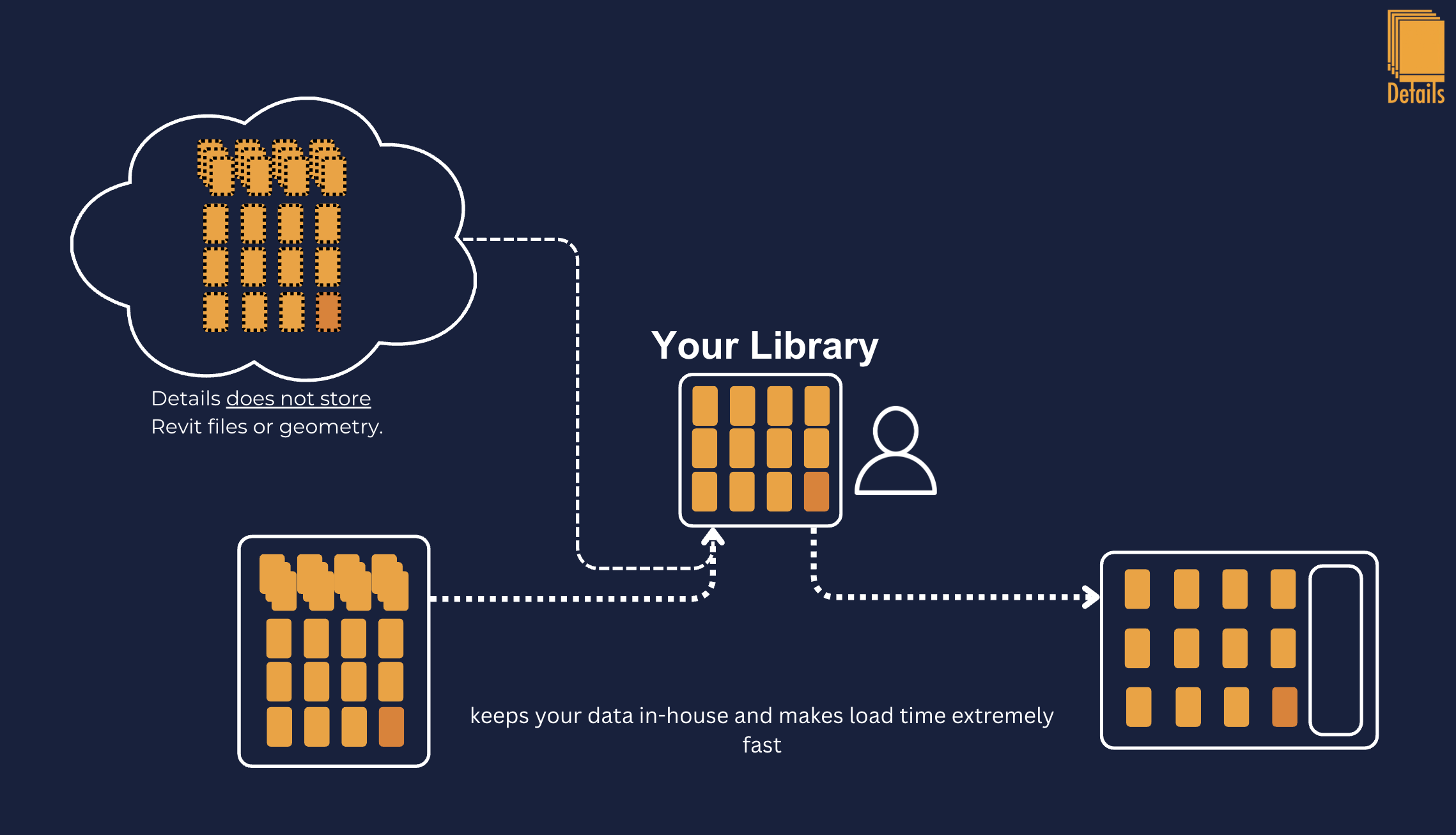
The first layer is architectural. Details never uploads your Revit models, geometry, or RVT files. We do not need them. The plugin reads small pieces of metadata locally: detail names, view names, family names, sheet names and that metadata is what powers Recs. Your actual building information, your geometry, your sheets, your title blocks, all of it stays inside the model on your machine. There is nothing for an AI to memorize because the AI never sees it.
The second layer is the AI itself. The lightweight metadata we do send is processed by Vertex AI inside Google Cloud's private network, authenticated through your firm's own identity, and returned directly to your plugin. By Google's terms, Vertex AI does not retain those inputs and does not use them to train Google's foundation models. Nothing about your firm's projects becomes part of someone else's AI tomorrow.
That combination — sending nothing sensitive in the first place, and routing what we do send through the most compliant AI infrastructure available — is what makes Details viable for the kind of work MEP firms actually do. Schools. Hospitals. Federal labs. Municipal water plants. The buildings that have to keep working when nothing else does.
Your clients are betting their continuity of operations on the firms they hire. Your AI tools should meet the same bar.