Why MEP Firms Don't Have a Detail Library
Walk into almost any MEP engineering firm in the country and ask the same question: "Where does your firm's detail library live?" You'll usually get one of three answers: a network drive, a SharePoint folder, or a senior engineer's personal Revit file from 2018. None of these are a content management system. They're filing cabinets. And the reason a real CMS has never taken hold in this industry isn't lack of need, it's lack of integration.
Engineers don't have a content problem. They have a content access problem. Every firm has hundreds, sometimes thousands, of well-drawn details sitting somewhere on a server. The question is never "do we have this detail?" it's "can I find it in less time than it would take to redraw it?" When the answer is no, engineers redraw it. Multiply that across a 50-person firm and you're losing six figures of billable time every year to duplicate work nobody can see.
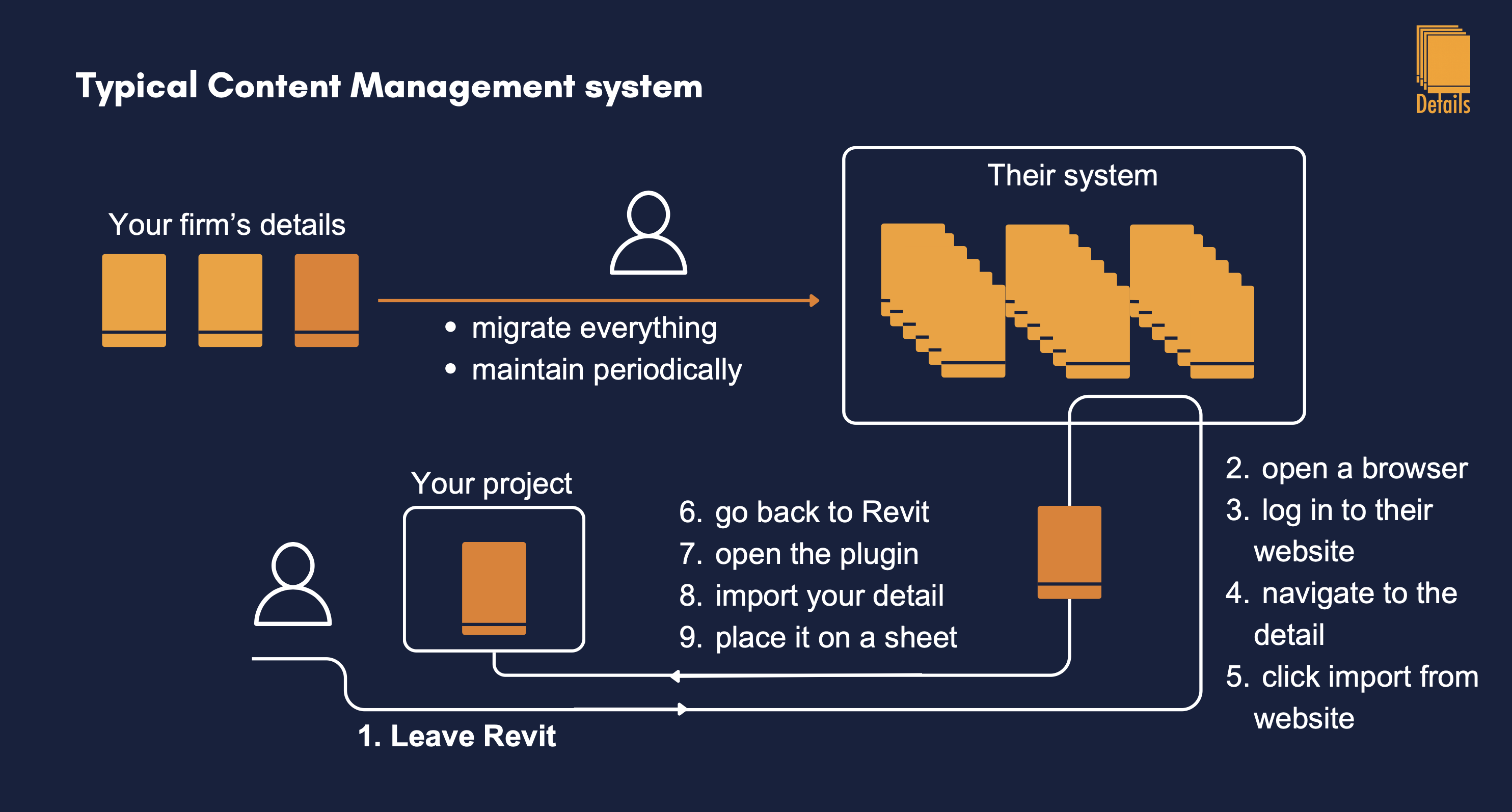
So why hasn't a CMS solved this already? Because every general-purpose content tool (Notion, Confluence, Box, SharePoint, even most "AEC-focused" knowledge platforms) lives outside the only application engineers actually open: Revit. To use them, an engineer has to stop modeling, alt-tab to a browser, search a folder tree they didn't build, download a file, navigate back to Revit, link or insert it, hope the scale is right, hope the title block is consistent, hope the levels match. By the time they've done all that, drawing it from scratch was faster. So they draw it from scratch. The CMS gets used for two weeks after rollout, then quietly abandoned.
The few tools that have tried to solve this with Revit plugins have run into a different wall. Most are configuration-heavy, require IT involvement to deploy, and ship with workflows designed by software engineers rather than design engineers. They sit on top of Revit but never quite inside it. Engineers learn to ignore the extra ribbon button.
This is the gap Details was built for. It isn't a content tool with a Revit connector bolted on, it's a Revit plugin that built to manage your firm's detail library. Search runs natively inside Revit. Detail placement honors your sheet templates and spacing rules automatically. Updates push to every user the moment a firm admin curates something new. Engineers never leave the modeling environment, never alt-tab, never redownload a file. The library lives where the work lives.
The result is the kind of compounding effect that's been promised by knowledge management software for two decades and never delivered in this industry. When the cost of finding a detail drops below the cost of drawing it, engineers actually search first. When they search first, the library gets used. When the library gets used, admins are motivated to keep it organized. When it's organized, junior engineers learn from it instead of guessing. The flywheel starts turning, but only because the friction was removed at the point of use.
If your firm has been told for years that you "should have a CMS" and it has never quite stuck, this is the reason. The CMS was never the problem. The integration was. Solve that, and the system you've been told you need finally starts working.